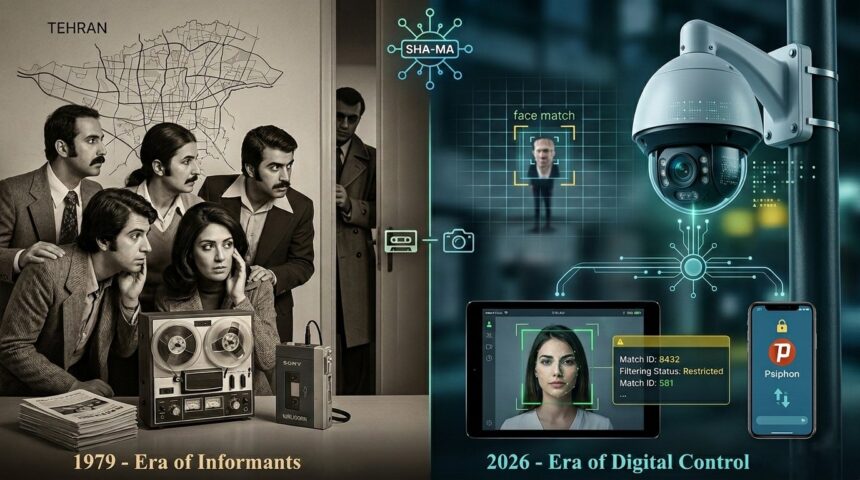
Surveillance Technology in Iran: A Five-Decade Evolution
When Iranians took to the streets in 1979 to overthrow the Shah, the government’s most advanced tool was a network of informants. This secret police force was known as SAVAK. Fast forward to today, and the Iranian government deploys artificial intelligence and facial recognition cameras. They also use sophisticated internet filtering to monitor and suppress dissent. The gap between these two eras tells a profound story. It highlights how surveillance technology in Iran has reshaped political conflict.
The 1979 revolution succeeded because information moved faster than the state could control. Cassette tapes carrying sermons were smuggled and copied. Leaflets circulated through neighborhoods. The Shah’s government could not track it all. Today’s government has learned from that history. It has invested heavily to ensure the same thing never happens again. Understanding the role of surveillance technology in Iran matters well beyond the region. It provides a preview of how digital control suppresses political opposition in the 21st century.
SAVAK vs. Smart Cameras: How Surveillance Has Evolved
SAVAK relied almost entirely on human intelligence. Agents posed as students, laborers, and shopkeepers. They read mail and tapped phones. It was effective enough to imprison thousands, but it had hard limits. A person could disappear into a crowd. The state simply could not be everywhere.
The Islamic Republic inherited this infrastructure but transformed it for the internet age. By the mid-2000s, Iran developed one of the most sophisticated national filtering systems globally. This is often called the “National Information Network” or SHOMA. It creates a state-controlled internet that can be isolated during moments of unrest.
During the 2022 Mahsa Amini protests, the government shut down mobile internet access. They restricted Instagram and WhatsApp. It was not a perfect blackout, but it slowed the flow of evidence. In 1979, no such tool existed.
Artificial Intelligence and Modern Surveillance Technology in Iran
Facial recognition has become a powerful tool in the government’s arsenal. Amnesty International has documented the use of cameras in public spaces to identify protesters. Once identified, individuals are often arrested days or weeks later. This delayed crackdown is designed to instill fear long after crowds disperse.
This kind of surveillance technology in Iran would have been unimaginable in 1979. It requires processing power and networked cameras that did not exist then. While machines can track faces, many critics argue that Why AI-Written Books Can’t Capture the Human Touch applies to surveillance too; algorithms often lack the nuance to understand human intent. Today, the cost of AI-driven systems has dropped. This makes them accessible to governments that could not afford them a decade ago.
There is also evidence that Iran sources technology from foreign partners. Investigations have traced components to European and Asian firms. This raises serious questions about export controls. For more, see our related piece on Silicon Valley’s role in global surveillance.
The Counter-Tech: How Protesters Fight Back
Technology is not a one-way weapon. Just as the government adopts tools of control, protesters develop countermeasures. The use of VPNs inside Iran has skyrocketed. Encrypted messaging apps like Signal are now essential for activists. In their struggle for autonomy, many find inspiration in classic themes of perseverance, much like How The Alchemist Redefines Identity and Agency in the face of overwhelming odds.
There are key differences in how technology served movements across decades:
- 1979: Smuggled cassette tapes carried sermons across borders.
- 2009 Green Movement: Twitter and YouTube let protesters share footage in real time.
- 2022 Mahsa Amini Protests: Activists used Starlink and Psiphon to bypass shutdowns.
Why This Matters Beyond Iran
Iran’s surveillance state is not a distant problem. The same AI and facial recognition tools are sold by companies with Western offices. American policymakers are focused on China, but Iran’s case shows the problem is broader. Democracies need clear rules about what technology can be sold to authoritarian regimes. Organizations like the Electronic Frontier Foundation document how these tools migrate to democratic countries. Iran is a case study for the world.
Key Shifts at a Glance: 1979 vs. Today
| Feature | 1979 Surveillance | Modern Surveillance |
| Primary Method | Human Informants (SAVAK) | AI & Facial Recognition |
| Information Flow | Cassette Tapes & Leaflets | Encrypted Apps & Starlink |
| State Response | Physical Mail Interception | Internet Blackouts (SHOMA) |
A comparison of a 1970s cassette tape and a modern high-tech camera used for surveillance technology in Iran.
Conclusion
The story of technology and conflict in Iran is unfolding right now. Tools that once required an army of informants now require only a few engineers. The revolution of 1979 happened because information outpaced control. While these digital walls grow higher every year, they can never quite silence the quiet, persistent conversations happening in the shadows of Tehran’s alleyways. Whether that happens again depends on who controls the technology and what rules the world enforces.